February 2024
“A nation trying to tax itself into prosperity is like a man standing in a bucket and trying to lift himself up by the handle.” Winston Churchill
In a recent speech, President Joe Biden asserted there are a thousand billionaires in the US, with an average federal tax rate of 8.5%. To us boomers, who grew up during a time when four children, one car, and single-income households were the norm, the dream of becoming a millionaire was elusive at best, and the notion of a billionaire—a thousand million—was simply beyond comprehension.
According to the most recent data, there are currently 735 billionaires in the country, so perhaps the President rounded up. But do the ultra-rich really enjoy a single-digit income tax rate? Let’s look at the numbers.
According to the most recent (2020) data from the IRS, the average federal tax rate by income breaks down as follows:
|
Income Rank
|
Share of Income |
Avg Tax Rate |
% of Tax Burden |
Avg Taxes Paid
|
|
Top 1%
|
22% |
26% |
42% |
$458,894
|
|
Top 5%
|
38% |
22% |
63% |
$136,091
|
|
Top 10%
|
50% |
20% |
74% |
$79,897
|
|
Top 25%
|
71% |
17% |
89% |
$38,396
|
|
Top 50%
|
90% |
15% |
98% |
$21,187
|
|
Bottom 50%
|
10% |
3% |
2% |
$504
|
Source: Tax Foundation
To qualify as a 1%’er required an AGI ≥ $2.8 million, and there were 1.57 million individual returns that equaled or exceeded that amount. With just over 700 billionaires in the country, it stands to reason they likely paid more than 26%. For example, in 2021 Elon Musk reported a $12 billion tax liability. Conversely, the bottom 20% of tax filers had a negative tax rate, meaning they received a refund greater than their withholdings.
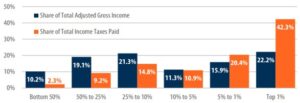
The chart below illustrates the differential one would expect to see associated with a progressive tax system. Interestingly, since 2001 the share of income tax paid by the rich has increased from 33% to 42%, while the share paid by the bottom 50% has dropped from 5% to 2%.
Source: First Trust Advisors
Now that we know where the federal government gets its loot, let’s examine the other half of the income statement; expenses. According to the Congressional Budget Office, over the course of the next decade, US federal expenditures will surpass revenues by $20.3 trillion, the national debt will top $54 trillion, and annual net interest will be $1.4 trillion per year.
The standard metric by which sovereign debt levels are measured is debt/GDP. It’s uncertain when, exactly, this became the yardstick by which to gauge fiscal responsibility, but it is a poor one. An individual or business can be in a position where liabilities exceed assets, yet still pay the bills. However, when payables outstrip cashflow it’s game over. To that point, federal tax revenues are currently $4.8T and expenditures are $6.4T. Of that $6.4T, net interest is $745B, or nearly one-third of revenue. By 2033 net interest payments will represent 40% of federal revenue.
To put this into perspective, in order to qualify for a manually underwritten conforming Fannie/Freddie home loan, the maximum debt-to-income (DTI) ratio is 36%. By 2025 estimated federal DTI (debt service/tax revenues) will be 35.4%, then quickly surpasses 36%. Ironically, Uncle Sam would be unable to qualify for a government loan.
US federal tax revenues exceed the gross domestic product of Germany, the fourth largest economy in the world, yet we haven’t had a balanced budget in over two decades, and the national debt is beyond $34T. We don’t have a revenue problem but, rather, a spending problem. Even John Maynard Keynes—who advocated for deficit spending during times of economic disequilibrium—would be appalled by this level of fiscal malfeasance. Despite the finger-pointing, both parties are culpable for this mess, and it won’t change until voters finally stop politicians from bribing the public with the public’s money.
The federal budgeting process is flawed to its very core and there are perverse incentives for legislators to be profligate as opposed to prudent. Unlike the private sector, where the Darwinian consequence for failure is extinction, government largesse is rewarded with ever-increasing funding for agencies, and increased votes for spendthrift politicians. Is it any wonder Washington bureaucrats are loathe to discuss spending cuts, and any mention of lower tax rates is always and everywhere attacked as tax cuts for the rich?
As Keynes opined, “taxation may be so high as to defeat its objective.” Meaning that the goal of taxation should be to raise sufficient revenue as needed to maintain a free and orderly society. But as Dr. Thomas Sowell illustrates in his article, Trickle Down Theory, virtually every scheme that increased tax rates was inevitably followed by lower federal revenues, whereas the opposite occurred when rates were reduced. Tax policy should be neither a tool for redistribution of wealth, nor a cudgel to punish the rich, but rather a thoughtful mechanism designed to maximize both economic growth and revenue. History has been crystal clear in that the more the government attempts to create an equal outcome, the result is a poorer and less free society.
Mark Lazar, MBA
CERTIFIED FINANCIAL PLANNER™
pathwaytoprosperity.com

Tax Stats
February 2024
“A nation trying to tax itself into prosperity is like a man standing in a bucket and trying to lift himself up by the handle.” Winston Churchill
In a recent speech, President Joe Biden asserted there are a thousand billionaires in the US, with an average federal tax rate of 8.5%. To us boomers, who grew up during a time when four children, one car, and single-income households were the norm, the dream of becoming a millionaire was elusive at best, and the notion of a billionaire—a thousand million—was simply beyond comprehension.
According to the most recent data, there are currently 735 billionaires in the country, so perhaps the President rounded up. But do the ultra-rich really enjoy a single-digit income tax rate? Let’s look at the numbers.
According to the most recent (2020) data from the IRS, the average federal tax rate by income breaks down as follows:
Income Rank
Avg Taxes Paid
Top 1%
$458,894
Top 5%
$136,091
Top 10%
$79,897
Top 25%
$38,396
Top 50%
$21,187
Bottom 50%
$504
Source: Tax Foundation
To qualify as a 1%’er required an AGI ≥ $2.8 million, and there were 1.57 million individual returns that equaled or exceeded that amount. With just over 700 billionaires in the country, it stands to reason they likely paid more than 26%. For example, in 2021 Elon Musk reported a $12 billion tax liability. Conversely, the bottom 20% of tax filers had a negative tax rate, meaning they received a refund greater than their withholdings.
The chart below illustrates the differential one would expect to see associated with a progressive tax system. Interestingly, since 2001 the share of income tax paid by the rich has increased from 33% to 42%, while the share paid by the bottom 50% has dropped from 5% to 2%.
Source: First Trust Advisors
Now that we know where the federal government gets its loot, let’s examine the other half of the income statement; expenses. According to the Congressional Budget Office, over the course of the next decade, US federal expenditures will surpass revenues by $20.3 trillion, the national debt will top $54 trillion, and annual net interest will be $1.4 trillion per year.
The standard metric by which sovereign debt levels are measured is debt/GDP. It’s uncertain when, exactly, this became the yardstick by which to gauge fiscal responsibility, but it is a poor one. An individual or business can be in a position where liabilities exceed assets, yet still pay the bills. However, when payables outstrip cashflow it’s game over. To that point, federal tax revenues are currently $4.8T and expenditures are $6.4T. Of that $6.4T, net interest is $745B, or nearly one-third of revenue. By 2033 net interest payments will represent 40% of federal revenue.
To put this into perspective, in order to qualify for a manually underwritten conforming Fannie/Freddie home loan, the maximum debt-to-income (DTI) ratio is 36%. By 2025 estimated federal DTI (debt service/tax revenues) will be 35.4%, then quickly surpasses 36%. Ironically, Uncle Sam would be unable to qualify for a government loan.
US federal tax revenues exceed the gross domestic product of Germany, the fourth largest economy in the world, yet we haven’t had a balanced budget in over two decades, and the national debt is beyond $34T. We don’t have a revenue problem but, rather, a spending problem. Even John Maynard Keynes—who advocated for deficit spending during times of economic disequilibrium—would be appalled by this level of fiscal malfeasance. Despite the finger-pointing, both parties are culpable for this mess, and it won’t change until voters finally stop politicians from bribing the public with the public’s money.
The federal budgeting process is flawed to its very core and there are perverse incentives for legislators to be profligate as opposed to prudent. Unlike the private sector, where the Darwinian consequence for failure is extinction, government largesse is rewarded with ever-increasing funding for agencies, and increased votes for spendthrift politicians. Is it any wonder Washington bureaucrats are loathe to discuss spending cuts, and any mention of lower tax rates is always and everywhere attacked as tax cuts for the rich?
As Keynes opined, “taxation may be so high as to defeat its objective.” Meaning that the goal of taxation should be to raise sufficient revenue as needed to maintain a free and orderly society. But as Dr. Thomas Sowell illustrates in his article, Trickle Down Theory, virtually every scheme that increased tax rates was inevitably followed by lower federal revenues, whereas the opposite occurred when rates were reduced. Tax policy should be neither a tool for redistribution of wealth, nor a cudgel to punish the rich, but rather a thoughtful mechanism designed to maximize both economic growth and revenue. History has been crystal clear in that the more the government attempts to create an equal outcome, the result is a poorer and less free society.
Mark Lazar, MBA
CERTIFIED FINANCIAL PLANNER™
pathwaytoprosperity.com